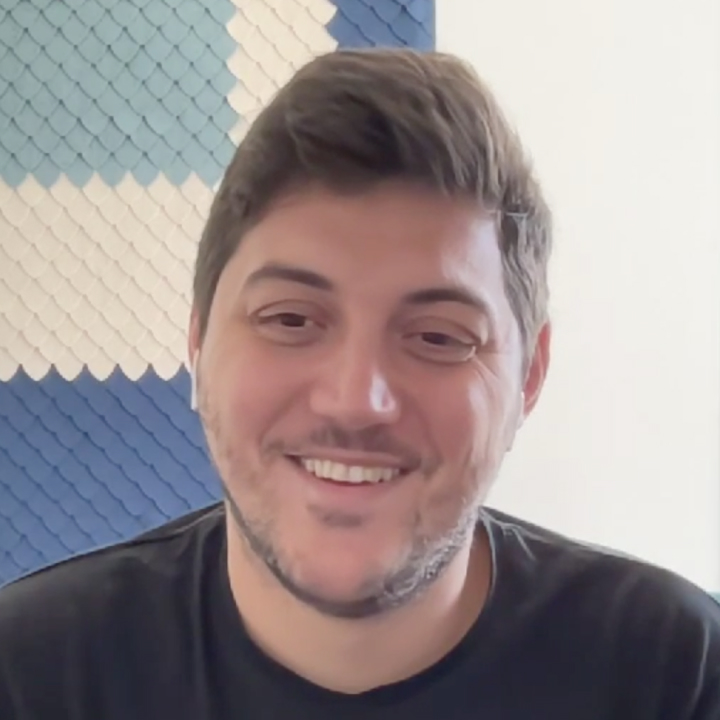
André
,
Oliveira
Founder & Chairman
at
Pixelmatters
Episode
2
From Freelancer to Successful Global Agency
Overview
Pixelmatters started by accident. André needed money, took some freelance gigs, and a project from Ghana changed everything. In this episode, Diogo sits down with André Oliveira, founder of Pixelmatters, a 50-person digital product studio based in Porto that has been growing for almost 11 years without outside funding. André breaks down what it actually looks like to run a bootstrapped agency at scale, from firing a top-three revenue client because they were disrespectful to the team, to why fixed price projects are a disaster and how the team retainer model helped them jump from $2.4M to nearly $4M in a single year. They also get into delegation, career growth paths, profit margins, and the mistake André says he'd never repeat: working with your spouse. If you are building a services business and want the honest version of what it takes, this one is worth your time.
Transcript
Diogo Dantas (00:01.354)
All right. André, first of all, thanks a lot for accepting my invite to be the second guest in our podcast. We have met quite a few years ago when I was straight out of the university and I interviewed for Pixelmatters. I didn't make the cut at that time, but we kept the connection. So I'm grateful for that. Being an agency founder myself, I want to say that I really respect
kind of everything that kind of your journey and where you are today with Pixel Matters. I think it's kind of admirable what you've accomplished so far. I know that there is a lot of things to come, but yeah, I just wanted to say like, thank you for your time and kind of express basically how much I admire the work you've done with Pixel Matters.
Before we get started, why don't you give us a short introduction about yourself?
André Oliveira (01:06.364)
Sure. Yeah, hello everyone and hi Diogo of course. Thanks for the invite and thanks for the kind words. I'm not sure if we were the ones deciding not to hire you or if you were the one like not accepting to work with us to be honest. I think it was the latter but my memory used to have better days so I can't commit to this.
Diogo Dantas (01:31.778)
Hahaha
André Oliveira (01:34.944)
to what I'm saying right now, but if we check email, can find it out. can find it out. Yeah, but yeah, glad, super glad that we have kept in touch and also excited to be on the podcast and to share a little bit of my story and hopefully to help fellow founders, especially like agency or services founders.
Diogo Dantas (01:41.068)
Yeah, let's do it. I'm curious.
André Oliveira (02:05.165)
Like ourselves too with with anything So yeah, just to try like very quick about very quick intro about myself
Andre Oliveira. I'm the founder of Pixar Matters. We are a digital product studio, currently around 50 people more or less. We are a Portuguese company. We do all of our work based out of Portugal, mostly based in Porto, which is the city where we were born. Even though we work just like Better Mistakes, the vast majority of our business is done with
international clients, mostly US based tech companies. I started the company in late 2013 while I was 23 years old. So we are in business for now almost 11 years and we have been kind of growing organically almost throughout all of these years.
We are a fully independent, bootstrapped company. And yeah, we try to be a very simple business that tries to get more money on hand than the one we spend. That's basically it. I don't know if this is enough for a quick start, but I'm giving my best.
Diogo Dantas (03:35.533)
Yeah, that's the...
Diogo Dantas (03:41.134)
No, it is. You're doing a good job. Maybe that's a good segue to kind of ask you about the journey that led you to found PixelMatters. You mentioned that you started in 2013, What led you to found PixelMatters?
André Oliveira (04:03.68)
It happened by accident. basically I used it to work for a company. I was there for roughly one year and a half. I decided to quit and my plan back then was to create a product. A product of my own. It was an app on the social sports field. The problem is that...
I didn't have any money and so I couldn't basically pay anyone to build the app. And also I don't know how to code so I'm a designer by trade, not an engineer. so I not only I wasn't aware how to do it myself nor I have the money to pay someone to do it on my behalf. And so...
As a result of that, even though I tried for a few months to actually raise some capital to build a product, but I failed quite miserably. And at the same time, I was like technically unemployed and I needed to money to pay my bills. And I started, because of that, I started to make some freelance gigs.
And those freelance gigs started to increase in volume and in size. And then one day a big project from Ghana. was the first and to this day it is the only client we have ever had from Africa. it was written in the stars, I guess. That approved the quote that we sent.
for a project of roughly 20k euros, which back then was like an enormous amount of money. And it was like, I worked with a colleague back then that became my co -founder, even though he left in the meantime. And we were like, maybe this is our excuse to open up an entity to receive this cash in a legal way.
André Oliveira (06:23.112)
And that's how it was. So we opened up an entity with the goal initially of receiving that cash and being able to issue like a legal invoice as per the tax authority system in Portugal. But from there things just started to escalate and one client brings another, one client brings another, one client brings another. And all of the sudden, by the end of our first year,
In business we were already like five, so we had to hire three employees and they were working out of our apartment and things just kept on going from there. But it was like this and I've been finding out that there are a lot of things in life that happen this way, like a little bit by accident and sometimes they are the best things that happen.
to us. I guess it was and it is one of those cases.
Diogo Dantas (07:27.214)
For sure, for sure. Cool. And coming back now to the 2024, what does a typical workday looks like to you? since you started a company, a lot of things changed and roles, responsibilities. So what are your core responsibilities right now and what a typical day looks like?
André Oliveira (07:48.16)
Of course.
André Oliveira (07:55.04)
Yeah, good question. So I basically run a company of roughly 50 people and the biggest that we were at Pixelmeters was 65. And I think that based on that experience of going from 2 to 65, I can more or less say that there are a few like...
buckets in terms of growth and how much you feel your role to change. And I think to me those buckets are more or less like from maybe 0 to 10 in which you are like basically involved in everything that happens, right? On the day to day or 0 to 15, 12, like something along those lines. And then you have the 15...
kind of 15 to 30 in which you are not you are like you are not anymore involved on everything and you don't know everyone on the team as well as you use it to to to do not in the sense that you don't know their names you obviously know their names but you may not know like what do the girlfriend of ex does in life or what does the husband of
why does in life, you know? So those kind of almost sometimes personal level relationships, it gets harder to... they start to get harder. And then from 30 to 35, up to 50 or 60, that's where I think your role really, really changes the most.
Because not only you are not aware of everything that happens in the day to day, in fact you no longer can. Because the amount of decisions and the amount of information is so heavy that it's pretty much humanly impossible to be on top of everything all at once. And so as a result of that,
André Oliveira (10:19.538)
I think the main realization that I have as a business owner throughout this journey was the impact and the importance of culture. That I think in the beginning it's quite hard for someone that never created a business before to understand the value of culture and what does it mean and it's like...
Sometimes we think it's just like some fancy words written on a notion page or on a Google Doc but in fact those principles and those values if followed it like if you live by them they like effectively make or break your your company and and you notice that when you grow because if you are there at all times
Diogo Dantas (10:47.16)
Hmm.
André Oliveira (11:12.552)
Okay, maybe you will enforce those values because you are the one making the decision, even if it is the very micro decision on like an administrative topic, right? But when you grow and you lose sight of those decisions, someone else will do them will do that decision on your behalf. And if they are not aligned with those cultural values, maybe the decision will be something that you don't really like or if you if you
Disagree with it you disagree with it and so things start to Those dynamics start to come to come into play Sorry, I'm not answering the question directly. I'm just giving giving it a Circle, but I will get there, but I will get there And so we there in mind Today my obviously like the then then dynamic of my day today is very is very variety
Diogo Dantas (11:54.638)
That's good context.
André Oliveira (12:10.1)
not only like in a week per week basis but in a moment of the year like for example maybe when you are on Q4 you have some weeks that are like finance heavy because you maybe have to make some you have to make some planning forecasting for the next year while in June or July you may not barely touch on finance
Diogo Dantas (12:16.664)
Mm
André Oliveira (12:38.976)
finance stuff. This is just a symbolic example. But with this in mind, my core responsibilities and my core focus are 100 % on ensuring that the culture of the company is as we want it to be in terms of the principles that we aim to follow.
Also on ensuring that we have opportunities coming in the door, meaning like new business, new clients, closing them, not only like making them come to us, but also then trying to close the deals. Brand slash marketing strategy in terms of...
external exposure and some recruitment as well depending on the phase. Right now, for example, we are not really on a heavy recruitment phase. In the past, we have had some of those and it's obviously a very important area for any CEO to be present to ensure that the team, the folks that join the team.
are culturally aligned and are also in the... Yeah, they share the same views of the world or similar views of the world, of the professional world, I mean, like the group does.
Diogo Dantas (14:21.962)
Mm -hmm. That's great. You mentioned that one of your roles now is kind of making sure that the culture is the way that you envision it to be for the company. Could you give us an example of how you accomplish that? I know that there might be multiple ways to do that. What is one example that you do that?
André Oliveira (14:51.134)
I think it always comes down to, right now as we record this podcast, one of the things that it's quite, I would say, I don't know if the right word is popular, but it's at least being widely discussed, is the founder mode theme that Paul Graham introduced after an event that I, what I combined with Brian Shatsky for Airbnb.
Diogo Dantas (15:05.543)
Mm
Diogo Dantas (15:20.099)
Mm -hmm.
André Oliveira (15:21.408)
And while we could go on for hours thinking about or talking about the founder mode and even though that notion has a lot of dangers if used incorrectly, it also has some some honors to it, right? And some things that I personally fully agree with. one of the things is to try
to be involved in what matters with some level of detail, just not knowing the basics or the core or the main ideas. And I think in my experience, when you go deep on things, it's usually when you realize that...
Diogo Dantas (16:02.552)
Mm
André Oliveira (16:16.862)
This is not how it is supposed to be. And that may mean, for example, in our case, that may mean the level of quality on the project that we are delivering for a client. That may mean how efficient are we being on an internal process that nobody sees. Those are the ones that fascinate me the most, like sometimes...
Diogo Dantas (16:41.795)
Mm -hmm.
André Oliveira (16:47.05)
those small things that happen on the shadows. it's the analogy that I usually make. It's like it's the bathroom of the restaurants. You know that analogy. You know a restaurant when you go to the restaurant. I like to think about my business in that way as well in the sense that in every corner of the organization people need to think in the same way like an engineer does on client work.
Diogo Dantas (16:52.099)
Yeah.
Diogo Dantas (16:58.146)
Mm -hmm.
André Oliveira (17:16.928)
It's supposed if you are like a HR person you are supposed to behave the same way just in different terms and in different in a different field But I guess those are those are two examples that I can give the other example that I can give that is more like client facing It's more when When you are an agency you have do you have this?
Diogo Dantas (17:25.634)
Mm
André Oliveira (17:47.328)
characteristic, that is the fact that your business, your culture, your internal culture is very influenced by the culture of your clients. I don't know if you feel this. Do you understand what I write? A big impact and it's different from like a product company because yes, you have customers and they obviously have an impact on you.
Diogo Dantas (17:59.232)
Mm -hmm. Yep.
Yep, it can have a big impact.
André Oliveira (18:15.87)
But they don't have like... Like when you are a product company, don't do like, for example, your teams don't do dailies with your clients, right? But when you are an agency, that is like normal. You doing a daily with your client or a weekly planning session or like whatever it may be. And so as a result, whether you like it or not, your clients...
they do have a clear direct impact on your own culture and in your business. And so we've come across situations in the past where some clients were like toxic and they were kind of like either disrespectful or...
Diogo Dantas (18:59.534)
Mm
André Oliveira (19:08.234)
close to being disrespectful to our team and sometimes in a continued stance like it wasn't like an isolated case and I remember that one of the values that we have I say have because we literally just revise them like a couple of weeks ago and we will publish them online soon was one of the values one of the values was happy clients and an happy team
No, not here, not with us. And a few years ago, we have a situation where a client was disrespectful and so that value was put to test and that client was like a top three in terms of revenue. And so we basically made the decision to to fire that client. So I explain to them, guys.
This is not okay. We don't accept this type of behavior. You are an important client to us. We cherish the collaboration. We cherish the technical challenge. The team likes the technical challenge, but the feedback that they are giving in terms of the posture that you are having on the day to day, it's something that we will not accept and we terminate the relationship in 30 days.
And so I remember that was like a big, big... It had a huge impact on the team morale because on that day, on that moment, they realized that the values that were written on the Notion page or on the website, they weren't only there just to be fancy. They were there for a reason and they were there to be followed like no matter what, you know? And I think for any leader...
Diogo Dantas (20:52.653)
Mm -hmm.
André Oliveira (21:06.452)
having those kind of moments, like making a hard decision that goes against your financial, commercial, like whatever interests, but benefits the culture and you are true, you are being true to your values, it goes a long way.
Diogo Dantas (21:25.428)
No, it does. I think that's kind of the, that should be the main understanding of values, as you mentioned, not just being something fancy copied from someone else's website or documentation. Awesome. And do you have from this experience, like through different stages and your kind of day -to -day operations or your daily role changing?
I'm sure that you dealt a lot with delegating. There is no way that you can build something without delegation. Do you have any advice, some tips that you could help me in this case be better at delegating? Because not easy.
André Oliveira (21:58.144)
Of course, of course, of course.
André Oliveira (22:13.824)
I think you can interview or you can record the podcast with a guy that has a company for 50 years and the person will say it's hard and I don't know how to do it properly, right? Because it's a struggle for everyone, I guess. But I think a concept that brought some comfort to me is that idea that
Diogo Dantas (22:26.559)
You
André Oliveira (22:40.8)
When you delegate and the thing that you use it to do is being done at like 90 or 85 % of the quality that you use it to have when you were the one doing it. Like, learn how to live with it. you know? Obviously this is like a general rule of thumb.
Diogo Dantas (23:03.384)
Yeah.
André Oliveira (23:08.8)
I, for example, I was lucky to come across people to whom I delegate and some things that I look at what they do today and I say, this person is way better at doing this than I ever was. And that's like the perfect case and the perfect scenario.
But obviously it doesn't happen every day or it doesn't happen every time. And sometimes you have a hit and miss kind of experience. I think, yeah, if I had to give some straight advice, yeah, be comfortable with that thing not being made, how you use it to do it like in a 100 % perfect way to...
get rid of any emotional attachment to that work because otherwise you never will be able to actually delegate it. And three...
Diogo Dantas (24:11.318)
Yeah, delegated.
André Oliveira (24:21.624)
Be there for the new person. Just don't abandon and okay now it's yours and I don't care about it anymore. We go back to the founder mode post once again. But it's true. It's like you really have to be there and to follow up. It's unfortunately some people sometimes interpret that as micromanagement.
Diogo Dantas (24:23.426)
Mm
Diogo Dantas (24:29.133)
Yeah.
Diogo Dantas (24:45.697)
Mm
André Oliveira (24:47.784)
I personally don't look at it in that way, like being there, but it's very important, not only to support the person, but also to have a notion on how things are going and understanding whether or not it is functioning properly as it is supposed to do.
Diogo Dantas (25:14.946)
Yeah, no, I definitely agree, especially the part of being there just to making sure not only that things are being done, the way, at least taking the high level direction that you would like them to take, not just fully delegate. then the person is like going completely a different way and being there to course correct that. Another thing that I learned that sometimes it's hard to, to
to not do is to when somebody doesn't go the way you were thinking, you are like, okay, I'm just doing it myself. And from that day, you start like going back in time a little bit and start delegating less when actually it's just like the bump in the road, you assume it, you course correct it and you continue delegating the way that you've been doing so far.
André Oliveira (25:54.11)
Yeah.
André Oliveira (26:10.204)
Yeah, I understand. I guess I've been there, done that many times. But there is something that I found over the years that is usually high performers. When the person is like a truly high performer, you can tell with like a couple of weeks of work, you know.
Diogo Dantas (26:34.392)
Mm
André Oliveira (26:34.624)
Not in the way, not necessarily in the quality of the execution, but in the level of curiosity and the genuine openness to learn that the person showcases. And in my experience, the vast majority of the times where I...
Diogo Dantas (26:53.944)
Mm -hmm.
André Oliveira (27:05.533)
regularly or repeatedly had to do the work of the person that I hired to do that work myself it readily ended well. So in my view of the world today that is a red flag. Not something that you do like once.
Diogo Dantas (27:15.192)
Mm
André Oliveira (27:34.26)
Like, once I hear something happened, then you do that, you did something on the behalf of the person. But if it happens like every week, that's probably a bad sign, you know? And I say this out of a place of someone that sometimes refuses to see that, you know? And I insisted, and I insisted, and I insisted. But one year was wasted, and in the end, it was obvious that, yeah.
it's not going to work and then it's even more painful in the end.
Diogo Dantas (28:05.165)
Yeah.
Diogo Dantas (28:11.65)
Yeah. In the end, you just created more work for yourself. Yeah, that comes with the job, All right. And one of the biggest struggles in general, with us, owners, is the sales process. And you mentioned that before that you are involved in some part in the sales process, like lead generation.
André Oliveira (28:15.375)
Basically, yes, basically.
Yeah.
Diogo Dantas (28:41.742)
closing clients in this journey, during this 10 year, almost 11 year journey, can you share with us some of the approach to sales that you took during the years that some things that worked, some things that didn't work that you could share?
André Oliveira (29:01.439)
Mm -hmm.
André Oliveira (29:05.396)
Of course, one of the things that I think that we never worked for us or we were never good enough to make work for us was the idea of outbound...
So I've tried many times to send a lot of cold emails to approach people on LinkedIn, but it really never resulted in basically anything. And the same goes for the notion of lead generation. I usually say internally that what we try to do is that we try to invest so much into our brand and into our marketing.
with the intention to have clients coming to us because they see so much value on the work that we do and the level of quality that we apply that you feel attracted to want to work with Pixelmatters. And that's has basically been our strategy almost forever. And it has some good things, it has some...
not so good things and you are a bit dependent on like referrals and kind of word of mouth kind of strategies. What I can also add in terms of like what works, right? Because this was about like the things that really didn't work for us. What works is...
In addition to what I already described of having like a very attractive brand, a very attractive portfolio, what works is like being very genuine during the sales process. When I say genuine, I say like being completely transparent with the client, whether you are a good fit, you aren't a good fit, whether you have made that type of project before or not.
Diogo Dantas (31:01.752)
Mm
André Oliveira (31:18.496)
We also bring our technical leaders into the sales process so the lead has contact with our head of design, our CTO, our head of product and so we discuss like sometimes the nitty -gritty of the details of the product of the client during a sales process and all of that is made to generate some confidence into the client that whenever you become a client and you stop being a lead
So the moment you sign a contract, this is the type of culture, this is the type of environment that you will find. And so you can be comfortable that this sales process is just, it's just not about like throwing sand to your eyes, you know? And that's really a key part of the way we try our sales process to be is really that...
Diogo Dantas (32:02.061)
Mm -hmm.
André Oliveira (32:15.316)
We look at the sales process as like as a deliverable. As something we want it to be just a glimpse of what the client will find if you sign the contract to work with us. This is the level of attention that we will bring to the table. How is this materialized? It is materialized in the way every single email is written.
no typos, no stupid sentences, just like thoughtful stuff. It is reflected in the materials that you share with the client. Are they like very well crafted, very well thought and tailored for the client as well? And also every other interaction on calls, just like the one we are doing right now. So...
Diogo Dantas (32:51.064)
Mm -hmm.
Diogo Dantas (33:12.525)
Mm
André Oliveira (33:13.596)
I think that's really important. And then every sales process for services is different from the other. It's what makes an agency so hard, it's very hard to create a repeated process because you are never selling the same package, right? It's always slightly different.
Diogo Dantas (33:37.186)
Yeah, exactly. And I imagine that over the years, related to sales, but now more leaning towards the pricing, that you probably try different pricing strategies, right? And which one basically ended up working the best for you and why?
André Oliveira (33:59.038)
What do you pricing strategies? what are you referring to commercial agreements or literally pricing?
Diogo Dantas (34:00.791)
So.
Diogo Dantas (34:05.39)
Yeah, so right now, not the value itself, like if it's $100 or $150 per hour, but there is different pricing strategies. For example, you can charge hourly, you can charge hourly packages. There is now like this monthly retainer or monthly subscription kind of thing, the Twitter popular thing, but...
André Oliveira (34:10.058)
Hmm.
André Oliveira (34:28.444)
yes.
Diogo Dantas (34:32.11)
Have you tried different ones over the course of the 10 years? And which one ended up like basically working the best for you guys?
André Oliveira (34:41.888)
Yeah, we kind of actively always try to think about the commercial models and try to iterate and optimize them according to the feedback that clients give us and according to the market as well. But I have like a very...
André Oliveira (35:06.697)
specific perspective on this topic. That is, if you search online you get lot of advice from guys like Chris Do, for example, on getting away from like billing hourly or charging for your time. And I kind of basically disagree with that and I think it is for two reasons. One...
If you think about business in a bootstrapped way,
If you charge for your time and if you charge significantly more than what you spend the cost of your time... If you charge significantly more than what that time costs you, you are by default being profitable and gaining money. And two, the other reason is that it's very...
Diogo Dantas (35:53.976)
Mm
André Oliveira (36:10.856)
romantic and it's very nice to say that you you you need to charge the value that your work creates and not the value that your time is worth the problem is how do you quantify the value that your work creates to this day i don't have an answer for that because it's so subjective like
Diogo Dantas (36:23.564)
You
André Oliveira (36:37.66)
I may argue, let's use you as an example. Better Mistakes creates a new website for my company, right? Depending on what I do as a business owner in terms of marketing strategy, client leads acquisition, demand generation, like whatever it may be, depends on what I do just on these three things, my website...
Diogo Dantas (36:46.734)
Mm
André Oliveira (37:04.434)
My new website made by better mistakes may skyrocket my sales and I may like triple or quintuple the double the size of my business in the next few years with a lot of in a big part because of the new great website that I that I have and maybe a new brand or whatever or I may get a new website and a new brand from you.
But I'm like a disastrous manager. I don't have like a great vision. I don't have any go -to -market strategy and my company fails in two years. Now tell me how do I quantify the value that Diogo has made?
Diogo Dantas (37:39.736)
Mm
Diogo Dantas (37:46.05)
Yeah, it's very hard to justify.
André Oliveira (37:49.06)
It's very hard and what is the alternative? The alternative is to do it like a package, right? Like I will do it the site for 30k. The problem with that is that you can give the twist and turns that you would like, but in the end that results in a fixed price project. And a fixed price project is a fucking nightmare, basically. You always lose money.
In my experience, I'm doing this for 11 years and I'm yet to find a fixed price project in which I charge the client 30k and it didn't cost me more than that to actually do it. Because things, you know, the devil is in the details. Things always slip here and there. There is a new round of feedback that is needed. A bug...
like a bug that some maybe it was simple to solve but the engineer was just wrapping his head around it and took a day or two to solve it and independently on how much you charge of the client the person will get the salary and you need to pay the salary and the associated taxes anyway and so what we have been doing at Pixelmatters was we started with offering just
Basically two models, fixed price project and what we call flexible retainer, which is basically hourly, hourly billing. And over the past few years, we have transitioned into two other models. That is, we kept the flexible retainer, like the hourly, but we got rid of the fixed price agreement. And that is because, as I just said, it was always a disaster, basically.
Diogo Dantas (39:19.63)
Mm -hmm.
André Oliveira (39:40.96)
And in repla... not in replacement but in order to continue to offer another option to our clients other than the hourly we have created what we call a team retainer. That is basically the assignment of a dedicated team like two engineers and one designer or two designers and one engineer whatever it may be.
along with the product owner, QA, those complementary roles and that team, depending on how many people there is on the team and the level of skill set that they have, like if it's a senior, it's more expensive, if it's a junior, it's less expensive, average will get you like a number, like the number, how much the contract duration will cost.
and it will also get you like a monthly billing amount, right? And by, and we, and then we, we sign the contract, we start to work. Let's say it is a six month agreement. Every month we charge the same amount to that client. And then we allocate the grid team, right? With with a grid characteristics. And then what happens is that the scope
is always... no, it's always negotiable, right? We can work on project A today and on project B tomorrow, it doesn't matter because what you are paying is for the location of the team and then when it comes to how to arrive to that pricing we basically use an average, like we use an average of in this case, for example, a full -time person
Diogo Dantas (41:07.788)
Yeah, let's change it.
Mm -hmm.
André Oliveira (41:33.76)
we consider that it works an average of 135 hours per month. While in practice what happens is that in October or November that nobody takes vacations you work 160 hours or 170. But then in August where everybody usually takes vacations you work like 80.
Diogo Dantas (41:41.307)
Mm
Diogo Dantas (41:53.422)
Hmm.
Diogo Dantas (42:00.28)
Mm
André Oliveira (42:01.268)
But if you look this through like extended period of time, basically one thing balances the other and it ends up being fair for both sides. And we ensure that we are being paid for our time. And as a result of that, we ensure that we are like being profitable and not paying to execute on our clients' projects.
Diogo Dantas (42:22.392)
Yeah.
Diogo Dantas (42:26.784)
Yeah, I like that approach that you guys took. It also avoids that part of the project if it is a fixed scope. Like if the client actually needs that flexibility, like to change scope or to adapt things, you don't need to be always saying, hey, it's not including the initial agreement. We need to renegotiate. yeah, I think that that flexibility is...
André Oliveira (42:46.9)
The hard conversations. The awkward.
Diogo Dantas (42:55.71)
It's pretty great. And it works like an extension, right? They grow basically their team, but they just pay to Pixelmatters instead of just hiring full -time Ford.
André Oliveira (43:05.984)
And it gives you cost predictability, which is one of the issues of the basic hourly billing, right? Because in one month you may charge 10k, in the other month you may charge 30k. And so it may get tricky.
Diogo Dantas (43:14.542)
Mm
André Oliveira (43:23.616)
With a model of that kind you get like the best of both worlds. get predictability in terms of the cost that the client will pay and also predictability for your own internal financial projections. At the same time you get scope flexibility because what the client is paying is for the location of the team and not for the accomplishment of ex deliverables.
Diogo Dantas (43:23.672)
Yeah.
Diogo Dantas (43:51.139)
Yeah, I agree. what is the flexible retainer that you're mentioning? Okay.
André Oliveira (43:57.664)
It's the typical hourly, like we work 10 hours, we build 10 hours, that's it.
Diogo Dantas (44:02.56)
Okay, gotcha, gotcha, gotcha. Awesome.
André Oliveira (44:05.694)
I know, it's not very inspiring, my personal view on this matter, but I like to think that sometimes the boring approaches are the best ones and I'm also yet to understand how some of the Twitter models... What is the expression?
Diogo Dantas (44:34.515)
André Oliveira (44:35.552)
They use an exp... subscription! Yeah, I'm yet to understand how some of those design subscriptions actually work in practice because if you offer 5k a month unlimited clients unlimited requests 24 hour turnaround time clap clap for you you may be an alien
Diogo Dantas (44:37.464)
Yeah
Diogo Dantas (44:45.975)
Yeah.
Diogo Dantas (44:54.038)
Yeah.
André Oliveira (45:02.536)
Because I don't know how a human being can turn that around.
Diogo Dantas (45:06.186)
Exactly that I don't understand How the unlimited thing can work from a business model from a human model, how do you do that? I Definitely should Yeah to break down. Yeah, there's a lot of things that only work in Twitter that's kind of one of the things I'm realizing I don't spend much time in Twitter, but I've been
André Oliveira (45:18.526)
You should invite one of those guys to the party.
And then you have an answer.
Diogo Dantas (45:34.85)
coming into terms like that happens with everything, right? News or Twitter, not everything that you see there actually works. So we should have that in mind. Since in the stealing the money talk, do you feel comfortable sharing kind of, because you created a really insightful blog post or.
page in your website about the 10 years from at Pixelmatters and in there you share as a bulk like how much revenue you guys generated in over those 10 years. I think what I would like to understand is from that bulk
In terms of company growth, like year one to year five, it averaged like one, two, three, or one to like 500 to one million, for example, from those average, think I would like to understand if that's possible to break down.
André Oliveira (46:40.594)
You mean in the early years?
Diogo Dantas (46:43.982)
Yeah, from the early years until you reach 10 years old, all that break, in terms of revenue growth, all that breaks down.
André Oliveira (46:51.892)
Yeah, yeah, so we did roughly 150k in the first year of operation and then we basically went on to double almost every year in the following six years or seven years. So we basically, it took us like
three years to get to a million, I think. And then from there, we went to two, 2 .5 more or less in 2020. From 2020 to 2021, we have a little bit of stagnation.
because 2020 was a bit of a hard year for us with some important clients that we lost in the midst of the craziness of the pandemic. And then 2022 was really like the year in which we made like a big jump in terms of size because we went from a revenue of 2 .3 or 2 .4 million...
Diogo Dantas (47:42.358)
Mm -hmm. Yeah.
André Oliveira (48:10.976)
in 2021 to 4 million and something in 2022. 4 million or 3 .8. I don't have the numbers in my mind right now, but close to 4. And that was precisely when we started to introduce the Team Retainer model a little bit more heavily, because it's a model that...
Diogo Dantas (48:24.43)
Mm
André Oliveira (48:38.4)
kind of invites the client for a volume, significant volume collaboration. And in 2023 and 2024, we are kind of also stuck in the 4 million mark for different reasons, but mostly because of the state of the economy.
and the tech market correction. So I was lucky that in the 11 years that I've been in business, six or seven years of this period were done with zero interest rates. so money was abundant and cheap. And in the last few years, things have become a little bit more harder. And so, yeah.
It's not that we are under threat of existence or anything of that kind, but it's now harder to close business than it used to be.
Diogo Dantas (49:50.072)
Yeah, it definitely is. And as a service company, what is usually your profit margin? I'm not saying, I'm not sure if I should ask this by project or, but I would say probably as a overall kind of end of year average, what would be the kind of the profit margin?
André Oliveira (50:10.815)
Yeah.
By project I don't personally I don't measure that because it's it's not like relevant because you need other people that are not client facing to run the company anyways and so what matters is the end bulk of things. In my my view I try to aim for the profit margin of at least 20
Diogo Dantas (50:18.028)
Mm
André Oliveira (50:42.752)
25%, ideally 30%. That's I think like the sweet spot. If you can get above 30%, there are two ways to look at that. And I've been there, that's why I say. One way is great job, great profit margin, enjoy your free cash flow. Other way is you may have an unhealthy structure.
And it doesn't matter if you are doing 35 or 40 % of profit margin a year, if you are completely burned out and if you work weekends and 16 hours a day, you know? And I've been that guy. That's why I say I know I have that... I call that the unhealthy profit margin, you know? It's literally unhealthy. And so these days what I try to do is to have an healthy...
Diogo Dantas (51:21.955)
Mm
Diogo Dantas (51:30.424)
Yeah.
André Oliveira (51:37.312)
profit margin of at least 25%, ideally 30%. I can say that considering the market correction over the past few years, a company like us that on average have a margin of roughly 30 % dropped to like 10, 12, which is in my view not good, even though I know
Diogo Dantas (51:59.829)
Mm
André Oliveira (52:06.612)
by some research that I've made that it is more or less the market average or the market standard. I don't want to be the market standard. I want to be a little bit better than that, you know? So, yeah.
Diogo Dantas (52:24.532)
Exactly. Great. And besides like profit margins, revenue, what are some metrics that you believe are important to track as an agency?
André Oliveira (52:45.16)
I've been recently, I requested recently to, for my accountant to include on the reports the data around revenue per employee and costs per employee. Because in an agency, the majority of your cost structure is tied up with people, right? In principle, you don't have that...
many other different costs other than the humans that work with you. And so having that number in mind, I think it's something that I'm starting to find to be very important. This of course, in addition to the data around the profits, revenues, profits, costs.
and all the basics of the P &L that every business owner should pay close attention to. I recommend on a monthly basis at least, otherwise you don't really have a grasp on how the business is going.
Diogo Dantas (53:59.404)
Yeah, I agree. And as you mentioned, one of the things that is the most expensive in these service businesses and a big core part of the business is people. And also one of the struggles is how do we find the best people to work with us?
Diogo Dantas (54:24.054)
Looking back, what are some of the things that you did and probably are still doing? Others, probably not. So they did to retain talent. think culture that you mentioned is probably one of the very important ones, but are there any other specific things that you did to retain talent?
André Oliveira (54:46.784)
In the peak of the tech bubble everything was about retention because people were getting like 10 or 20 LinkedIn messages a day offering them for new jobs. So it was right now things are a little bit more calm. I don't know if it is to last but at least for now that's how it is.
But a couple of years ago, that was our day to day. It was all about retention. A lot of those conversations and actions were around like conditions, like benefits and perks and better salaries and all of that. And while I do think that is...
That is important, especially the salary piece and to pay people well and to give them like the financial stability that you need to be able to do a good job and be stable in your life. I think one of the best retention strategies that you may have is really keeping people engaged and...
providing them opportunities to grow in their professional life, you know, like more interesting projects, more exciting challenges. If you manage to do that, and by doing that, you also need to be an attractive brand that will bring good clients in. If you manage to do that, paired with
Diogo Dantas (56:12.749)
Mm -hmm.
André Oliveira (56:40.042)
good financial conditions and work conditions as a whole, obviously. I'm not speaking about like the basics, like a computer or whatever, right? That's a given. If you pair that with the financial stability and a good culture, which in most cases people refer to as there is a good environment, you know, in Portuguese we would say, a bom ambiente.
Diogo Dantas (57:05.806)
Mm -hmm. Yeah.
André Oliveira (57:10.09)
for the Portuguese listeners. This is something that you usually... It's very often for you to hear, right? I like my colleagues and there is a good environment. That's culture, right? And that sometimes, think, keep people challenged and a good culture is really the ultimate best retention tools that you have because money is money.
Diogo Dantas (57:10.22)
Mm -hmm.
André Oliveira (57:39.892)
mean, you may be able to pay more, you may not, but if that's the only thing that you have people, that you manage to retain people by, I mean, it's inevitable. One day, there will be someone that you'll offer a little bit more and the person will go away.
Diogo Dantas (57:47.64)
Mm
Diogo Dantas (57:58.828)
Yeah, true. And with that, in terms of give them challenges, allowing them to grow internally, at what point, I'm assuming that you have that now, at what point did you felt the need to create some type of career growth path so people know...
where they should go or where they should reach in order to go to the next level in terms of salary or in terms of responsibilities because that's kind of also the type of challenge that a lot of people are also looking for.
André Oliveira (58:35.296)
We started to feel that in 2020, 2021, which was by the time that we reached for the first time the 40ish, more or less 40 employees mark. I think that by 35, 40, you start to get that kind of feedback being more common, being a pattern. And so you realize that you have to do something about it.
Diogo Dantas (58:39.544)
Hmm.
André Oliveira (59:04.704)
Now, the right moment, that's like hard to say. I would advise and looking into my experience and the things we did well and the things we did wrong. In our case, I think we were late to create that. And when we did create, we were already like in reaction mode. We were already running against the time.
And so that creates a type of pressure, not only in terms of the people's expectations, but in your own expectations as a leader that doesn't help you to make the right decisions. If I were starting today, I would much rather start like the sooner that I foresee that need.
Like nobody's complaining about that. But I, as a founder and as a leader, I'm already seeing it at the distance. It's coming. I would start there. And why? Because one, you start to pave the ground for something. You give people the indication that you care about their future.
which is also good from a cultural standpoint. And it allows you to build on MVP mode brick by brick. Maybe the first version is very basic, it almost doesn't have nothing. It's very basic, really, really, really basic, but it's something already. If you do that when you are 40, when you present something to the team, they don't expect it to be basic.
They expect it to be something fully fleshed out. And so that may take you a lot of months to be done. And as a result of that, you just, as time goes by, the problem just gets worse and it's a challenge.
Diogo Dantas (01:00:57.805)
Yeah.
Diogo Dantas (01:01:17.646)
That's great, that's great. As we wrap up this session, I have some finishing questions. Now looking back at the 10 years of building, in my opinion, a great business, what was the biggest mistake that comes to your mind right now?
André Oliveira (01:01:42.464)
For several years the biggest mistake was to work with family, slash in this particular case with my wife. So we are together, we have two kids that we love and we love each other. But it was painful in many moments to get home.
Diogo Dantas (01:01:53.921)
Hmm.
André Oliveira (01:02:06.492)
and not having that peace of mind of just enjoying being with my wife and she enjoying being with her husband without work in the middle. Because people say, yeah, we separate things very well and one thing is at the office and the other thing is at home. In my opinion, that's bullshit. It's like saying that you are the prime minister.
Diogo Dantas (01:02:18.498)
Yeah.
André Oliveira (01:02:36.138)
but you are the general manager of your party and you are in an event in the... not as prime minister but as general manager of your party. No, man, it's impossible to distinguish. It's like... It's always... It's always so... Everything is so mixed up. And so that brought a lot of struggles to my well -being.
Diogo Dantas (01:02:48.916)
Mmm. Yeah, sure.
Diogo Dantas (01:02:59.671)
Yeah.
André Oliveira (01:03:05.148)
and our well -being over the years so I don't recommend it to anyone. Other mistake I think will be tied up with what we just discussed which is not taking action on something.
quicker when I saw that it was either going to be a problem or something that eventually will come to surface, you know? And it may be a person that doesn't really work or it may be a tool that you need or it may be a process that you need or it may be a piece of documentation that you need, it may be anything. But something that...
Diogo Dantas (01:03:34.168)
Mm -hmm.
André Oliveira (01:03:53.012)
that I think was a mistake and then led to uncomfortable situations, I would say that as well.
Diogo Dantas (01:04:02.296)
Great, that's great. And last question. I always like to finish our episodes with asking what is one thing that you're currently struggling with right now?
André Oliveira (01:04:19.146)
that I'm currently struggling with right now
Diogo Dantas (01:04:25.196)
If you could use, for example, this question is with the main goal of hopefully when we have multiple guests, having them connecting, like if one person was very good at one thing and the next person in the future is struggling with this problem, let's connect them to see how this person can help this one.
André Oliveira (01:04:42.197)
Mm -hmm.
André Oliveira (01:04:48.254)
Yeah.
I would say it's probably really like a...
André Oliveira (01:05:02.58)
I would say closing new clients. They come through the door, but then it's hard to close them from leads to clients. I don't know if this is something we are doing wrong. I hope that is not the case or it's just like the state of the market. But yeah, that's, guess, what comes to mind right now. I'm sorry, maybe not the most inspiring answer, but...
Diogo Dantas (01:05:05.261)
Mm -hmm.
Diogo Dantas (01:05:24.628)
No, no, no need to be inspired. To be inspired I'll go to Twitter. I think that's a real struggle and thanks for sharing. And with that, that's it. Once again, Andre.
André Oliveira (01:05:32.605)
Yeah.
Diogo Dantas (01:05:39.854)
Very inspiring. think it's really great to be able to talk with you with such a, like, I think remarkable milestones that you hit. And I'm sure that this in 10 years is just going to be like the, what are we talking about the first, the year first from the first year to the year three, it's going to be just a small part of the business. Now it will be much bigger, but thank
for sharing and then thanks again for your time.
André Oliveira (01:06:11.7)
Yeah. Thank you so much.
Diogo Dantas (01:06:15.862)
Alright