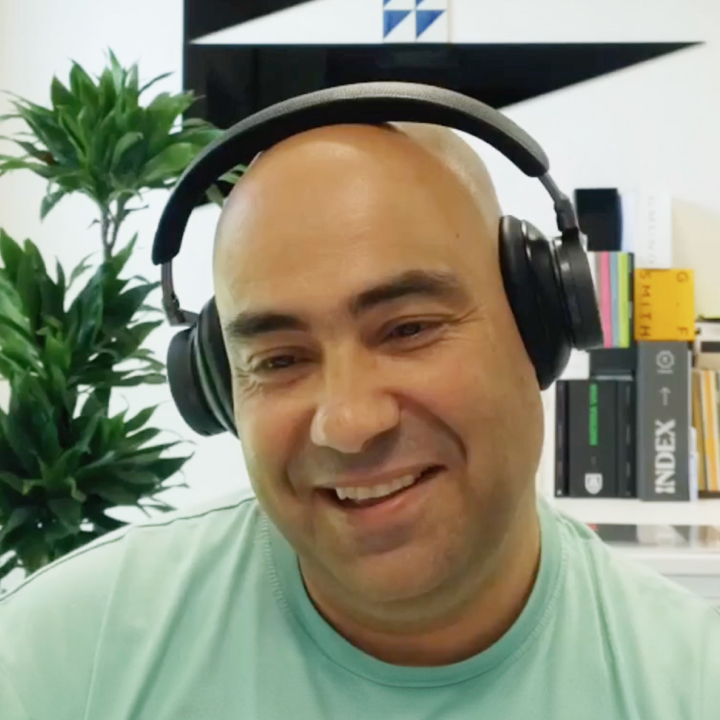
Adriano
,
Esteves
Founder & Creative Director
at
Bürocratik
Episode
6
Design What They Need, Not What They Want
Overview
Adriano started in chemical engineering. Then the internet arrived at university and nothing was ever the same. In this episode, Diogo sits down with Adriano, founder and creative director of Bürocratik, a digital branding and interaction design studio based in Portugal with 19 years of work behind it. Adriano has never sold design to anyone. Every client for two decades has come through work he was proud enough to publish. They talk about why every project starts with typography, how Bürocratik takes creative ownership as a condition of working together, and why the studio caps at 10 people on purpose, not because they can't grow, but because fun matters more than profitability. Adriano also gets into how AI is changing the inception of projects, why audio has become a serious part of their craft, and what it looks like to add a custom soundtrack to a website without the client knowing until it's live. The struggle keeping him up at night: not the work, not the team, the people on the client side making decisions. If you care about craft and want to understand what it looks like to build a studio that never compromises on quality, this one is worth your time.
Transcript
Diogo Dantas (00:01.868)
Hi Adriano, thanks for taking the time to talk with me today. Let's start simple. Let's start by who is Adriano.
Adriano (00:14.707)
Uh, again, was a 52 years old chap. Uh, and, uh, founder and creative director of Bürocratik for the last 19 years. Um, this is our 19 years. I started 20 years ago. Um, and basically I'm still doing the stuff that I wanted to do. Uh, when I decided that I wanted to make design when I was a chemical engineer student in Quimbra in 95. So that's.
That's still who I am. Not searching because I found myself. But still doing it.
Diogo Dantas (00:49.928)
Yeah, glad that you found yourself. There are some people with your age that they still don't know. So glad you were able to. And who is, who is Bürocratik and why the name Bürocratik
Adriano (00:51.987)
Yeah
Adriano (01:06.067)
The name started, it was the first name that I associated with my own chain. So the story is very long. I started 30 years ago doing a website for Moonspell, Portuguese band. It's also still touring. So we are both still doing it. And I created the first company after some years of the decision of making design or not. I created the first company all with the...
Diogo Dantas (01:21.975)
Mm-hmm
Adriano (01:36.051)
chemical engineers from my degree. So we were five chemical engineers doing design, doing websites. And that company was bought for another one because we failed miserably on a lot of stuff. So we were not able to do it ourselves. So we were bought and I stayed there two or three years. And then I decided that it was enough to try to do it.
on my own. So, Bürocratik was the name on the favorite browser to create a company and all the bureaucracy associated with it. And it stayed. So, that was the origin of the name.
Diogo Dantas (02:18.09)
Nice. So you said that the first business that you started with another bunch of chemical engineers that were actually doing design, it fell.
Adriano (02:24.851)
I was doing design, the others are tech and business. So I was the only designer.
Diogo Dantas (02:31.015)
got it. Okay, got it. So but that company, you left two years after, but it was still acquired, right? nice.
Adriano (02:40.839)
Yeah, it was acquired. Yeah. And only two of us, the developer and designer came to the new company. Yeah.
Diogo Dantas (02:49.352)
Okay, that was good. You mentioned that you failed miserably, but it could be worse, I would say.
Adriano (02:54.279)
Basically, yeah, it could be worse. It could be worse. So I was on a chemical engineering degree and the internet came to the university. So basically it was like an awareness of something big and a lot more exciting than chemical engineering. So that was the, that was the thing. But it takes time to know how to do design, know how to do business and all that. So it was like 10 years failing.
Diogo Dantas (03:13.207)
Yeah.
Adriano (03:24.113)
the first 10 years is always failing. There's no shame on doing it because that's the only way, at least to understand what you want to do from that point forward.
Diogo Dantas (03:33.42)
Yeah. Nice. And what type of work do you do at Brocratik?
Adriano (03:41.203)
So we do digital branding. Most of the deliverables are websites. People come to us to make websites, but we do brands from scratch, from new brands, from rebranding, extend those brands to digital and then the website. So digital branding and interaction design is basically where we
Diogo Dantas (04:02.318)
cut it. So does it happen or is it well does it happen that sometimes clients come to you directly for the need that they have which is website but then you actually look like when they are kind of when they are still a lead and you are quoting the project you're like well you came to us as a website but the brand man we have to start there.
Adriano (04:29.275)
Yes, we always start with the brand. think we only, only in two projects from, for these two decades, we didn't change the brand because it was impossible. But all the rest, we did some polishing, we did some rebranding, we did some extensions. So it's always starts with branding. Yes. Especially typography. We always change typography. It's not what the problem is.
Diogo Dantas (04:48.822)
That is it.
Diogo Dantas (04:52.878)
Yeah, you just can't, right?
Adriano (04:57.915)
I can, but it's not the same thing. So there are some things that you can work with others. It's impossible and typography. It's really, it's a, it's a demand. you, you, if you've seen our website, have on the work, no pop-ins. never use pop-ins. So that's, that came, that was an internal joke and then it became like the main tagline for work, but it's very important. And the client needs to understand why.
Diogo Dantas (05:00.749)
Yeah.
Diogo Dantas (05:09.078)
It's key.
Diogo Dantas (05:14.786)
Yep.
Adriano (05:27.187)
So we show that, but always, Every project starts with typography. There's no other way, at least to me.
Diogo Dantas (05:33.91)
Nice. No, no, no, it makes total sense. It's kind of the foundations. And how do people like how the clients usually react when like you come to them is like: Hey guys, sorry, there is a different, different proposal here.
Adriano (05:47.505)
Yeah. So it takes, it takes time to understand the full process as much as I can explain what we do and how we do it. When we start doing it, it's when the pain starts. So some clients trust since the first second, others we finished the project and they still don't trust us. So it depends on how much the client wants to have ownership of things.
The much ownership he wants, the less we can do what is necessary to do. So it depends. There are some projects that we take ownership as a condition to do it. And those happen a lot. We only do it if we decide stuff, if we are the guardian of the brand. Otherwise, if you don't do that, it's impossible because you have to negotiate with 10,000 people. It never works, right? So ownership is, I would say.
Diogo Dantas (06:38.327)
Yeah.
Adriano (06:46.203)
the main thing to grasp and see if it's a red flag or not. And sometimes it fails. This is not, but I'm always, I mean, on the interface with the client and with the team. I know when something is a red flag and what we can do and should do. So I'm feeding the client right away and not just come back with something. So that's also important on how to sell design.
Diogo Dantas (07:09.806)
Definitely. Was it always like this? you don't react as an executor, but you actually tell the client, hey, I know that you think you need this, but you need actually this and that.
Adriano (07:25.457)
Yeah, it's a process. So for the last few years, I've written a book about the story of the company. So I know exactly when I started, when I understood that what we had to do. And there was a project, a website, a big website where the client changed the scope three times and for the same budget. And it was the last time I said, no, no more bullshit. This is it. We need to do this and this and this. And from there, from there.
it was the best, decision that we could do because we design was, sorted, quality was sorted, but ownership is something that it's even more important than all the rest. So with that, I always say that you have to negotiate with the client, not just the budget on the beginning, because that's the obvious thing, but starting question things. we even change names of stuff. that's kind of, of, of depth that the client is not ready.
But it's important to understand if it's something that is negotiable, if it's open, if it trusts you or not. That's very important in the beginning, in the first weeks.
Diogo Dantas (08:34.094)
Yeah, and if you don't ask, you don't know, right? So...
Adriano (08:36.901)
Exactly. Exactly. And you, you, with time, you understand, you need to understand who's in charge. So that's the first thing that I ask. And I need to talk with him or her from day one, not just the interface. So, because you can talk with the interface, you can explain and he buys the stuff. And then when he goes back, it's, he brings everything. No, it's not this. It's not that. So that's the main struggle on doing.
big transformations, big digital transformations like websites because websites it's it's a lot, it's everything, it's strategy, it's brand, it's content, it's sales, it's everything. So it's very important to be on the same page and it's the biggest difficulty.
Diogo Dantas (09:21.006)
And your projects and everybody that will be able if you they don't know you or burro they will be able to quickly understand the Complexity of the projects that you guys do in terms of custom interactions audio video 3d whatever So it seems like you guys do whatever is needed for the project not like if it is including the scope or not sometimes you might
Adriano (09:28.136)
Mm-hmm.
Adriano (09:38.771)
everything
Adriano (09:44.413)
Mm-hmm. Yeah.
Diogo Dantas (09:50.024)
have to make those decisions because the client changes scope three times and you can't at this point do anything that you might want. But when you are as an agency founder myself, when you are coding a project is already pretty complex and kind of ambiguous, like what the project is going to be.
Adriano (09:54.472)
Yeah.
Diogo Dantas (10:14.574)
because you are creating one image, the client has another, and everybody that is involved in the project has a different one. So when we add these types of custom materials that you create, like audio, video, when you are quoting, you don't know what it's going to be.
Adriano (10:33.319)
Yes, we never know when we start, never know. We have an idea and we upfront tell how much audio will cost if you want to make a soundtrack. Not to every client because some clients, the much they know of what's the extras, they will remove. We don't need it. So my approach is there are two steps. First, the step to please the client with everything that he needs for it.
Diogo Dantas (10:51.246)
Yeah.
Adriano (11:00.945)
a campaign for going to the market for whatever. And then we work in background and polishing it. So there are some websites that we release a first version just for the website, just for the client, a landing page or something like that. And then we work on background and then the music appears and then yeah. So, and the reason is that, and this is hard to, to, tackle, but when we start, when we accept to do any project, we need to be.
Diogo Dantas (11:16.962)
Hahaha
Adriano (11:29.715)
the brand, like I said, we need to have ownership and it's our decision to spend 2k on an audio, on music, because I'm the owner, right? So I'm budgets. So we agree on a budget and then I spend it and the client knows exactly in the end what's being spent. But basically we are the owners because that's the only way. There's no way you could do what we do if we don't own something.
Diogo Dantas (11:39.298)
Mm-hmm.
Adriano (11:58.683)
at least at the same level as someone on the side of the client.
Diogo Dantas (12:01.486)
Yeah. So when you just to make sure that I kind of understand, because I think that's kind of at a different level of how I quote projects. So from what I understood, you provide, for example, let's say a project costs 50 K and you say, Hey client, this costs 50 K and
This is kind of what we will get for the 50k. If you want, for example, audio, you add 2k. If you want video. Okay.
Adriano (12:33.053)
Yes.
Adriano (12:36.573)
Yes. Yes. Yes, we do that. So we agree on a ballpark and then we have the extras that are not part of that ballpark. Like typography is never included. It's a minor part, but it's not included because we don't know the typeface. So the process only in the end, we know exactly how the project will be. One example is Kozowood, the website that we did three years ago. And there was no idea that we would do music.
Diogo Dantas (12:49.236)
Mm-hmm. Yep.
Diogo Dantas (13:01.59)
Mm-hmm.
Adriano (13:05.575)
but we had space to do it. So I hired a musician to make the composition more silenced than music and give the flow with test it. And then we found someone that played with Marimba, the wood instrument because it's a wood house website. And it was perfect. And the client never knew that we would add music to it. Yeah, that's one example.
Diogo Dantas (13:05.837)
Yeah.
Diogo Dantas (13:20.098)
Mm-hmm.
Diogo Dantas (13:28.78)
Nice. And this client in particular, they knew about the music once the website was live or it was part of the...
Adriano (13:36.133)
It was not immediate, it was one month later when it was finished,
Diogo Dantas (13:40.374)
Nice. Okay, that's funny. And I think you answered a little bit this question, is now to add to that, you have product management. you have multiple parts that have to play together at the end.
Adriano (13:54.152)
Mm-hmm.
Diogo Dantas (13:59.586)
And in the beginning, you don't know, and you have to provide an estimate. This will take three, four, five months to do. Does that work in similar to what you mentioned about the quote, which is, guys, four to deliver what you had in mind initially is like three months, but then music is one month more?
Adriano (14:01.736)
Yes.
Mm-hmm. Yes.
Adriano (14:16.241)
Yeah. Yeah. Time wise, it starts in four, five months. We don't do websites and brands without at least four months. Normally startups work with three months and it's not, it's impossible. Three months, it's, it's good to create the brand, to create the brand universe, to the narrative design, but the development on top of that takes a lot of resources. So, and that's the type of
Diogo Dantas (14:24.845)
Yeah.
Adriano (14:42.747)
negotiation that you do. If it's something that it's non-negotiable to have the website in three months, we can't help. We can't. It's impossible to help because it's... And some clients move on, some clients say. So basically that's good because if someone stays, it's more resilient for the ones ahead. If it goes, it's one less problem.
Diogo Dantas (14:52.397)
Nice.
Diogo Dantas (15:07.658)
No, for sure. For sure. It's, it's, it's good that you know, like your, your limits and kind of your boundaries. because not sometimes there's that I talk for myself, there is that part of us where we try to please the client because they are kind of the ones giving us the money. but it's, think it also comes with experience. kind of learning to say no.
Adriano (15:13.427)
Mm-hmm. Mm-hmm.
Adriano (15:24.435)
Mm-hmm. Yeah.
Diogo Dantas (15:35.68)
a project will not move the needle because in the beginning everything moves the needle. So you might be keen to accept more things and to accept things sometimes that you shouldn't. But time goes by, you're like, no, I know what I want. It seems like you guys are at a point where you know the type of work that you want to do. You don't want to do work that you would not be proud to show in your portfolio.
Adriano (16:00.485)
Every work that we announce is real work. we don't have, we only publish, well, we publish 100 % of what you do. There's only one or two websites that were failed and we never published them. All the rest, we struggle hard to get into a final product. And some are more difficult than others. Some products end before the website is done. It happens. So the risk that you...
take on picking a client or accepting, you need to see all that if it's something real, it's solid, make the right questions. because when you talk with the client from, especially from startups, everything is done. The product is done. We will, in three months, we will have this on, no, it's one year, two years, three years, and there's no transparency. So you need to see the problem.
So working and making questions and give me this and give me that and client doesn't have it for you. You start seeing that something is failing and then they improvise the shortcuts, they make shortcuts and say, want this remove that. And so you see, understand when the process begins, what's bullshit and what's solid.
Diogo Dantas (17:17.832)
And as I mentioned to you in the beginning, before we started recording, in my opinion, all the work that you guys do, and now that you mentioned that everything that you publish is real work and you try to publish everything that you do, so there is no like, we only publish the good ones, the bad ones, like we never see the day of light.
Adriano (17:41.041)
Everything.
Diogo Dantas (17:44.566)
That is even more impressive because everything, every, every work that you, you, publish is like flawless. Not in terms of just the design quality, but also like development and being in the, the industry myself, I know how many of the things, how hard it is to accomplish many of the things that you guys do. So how do you guys.
perform QA. How QA works at Bureau.
Adriano (18:21.363)
Yeah, that's a tough, that's a tough one. The main, the main, um, um, there are some struggles, right? What you see is sometimes easy, but it's never something that we have examples where we spent literally two months making R &D for the specific thing. are at least three that I remember, uh, that we were pushing so hard that the technology was not ready. Uh, so involving masks and video.
Diogo Dantas (18:48.429)
Mm-hmm.
Adriano (18:51.249)
WebGL, so it's a compromise that it won't, it, it needed something like the release of M1 from, Apple. And what we had at that point was flawless. But, one week before that, before we had something to test on a new processor was not. So it was a fail and we spent like two months doing it and pushing it and optimizing the masks and the size of the, so it was one example, probably the worst.
But in the end, we learned so much with it that we use on almost every project ahead. So it's not that you're losing money. You're losing time. Yes. But you're investing on what's ahead. So from there, especially with WebGL, it's something that you spend a lot of time and it's not, we push almost all websites without WebGL almost, except one that was 100 % WebGL. But we...
love to push us, push ourselves up to a point, right? There's some, it needs to be reasonable. It needs to be good. And in the end, it needs to solve the problem from the client, from the website. So, so yeah, we always push hard because the investment that we do, it's not just for the client that we are finishing the website. It's for the next one and for ours ourselves.
Diogo Dantas (20:05.208)
Mm-hmm.
Diogo Dantas (20:16.908)
Yeah, no, absolutely. And in terms of like quality assurance, do you guys, I, at least from the, your website, I don't see anyone that is a formal role of QA. So I imagine that is a mix.
Adriano (20:30.203)
No, no. So we don't have, We don't have project managers. We don't have accounts. We don't have nothing. We are just designers and developers. So I do a lot of those stuff. So I'm dealing with a client and dealing with the project management and content and design the beginning typefaces and brand among all that. So we don't have project managers we use one online tool where everyone from the client and everyone from my team
is on the same. It's super horizontal. If someone asks something, everyone sees. That's how we avoid project managers. We don't want to be more than 10. We will be 11 in two months. But 10 is our limit. Because more than that, it doesn't work. the system gets more complexity. And you need people. So we reach to a point where
fun is more important than profitability to me, especially to me. And that's, think that's the main reason of why our stuff is different is that the guy that is in charge treasures the final result more than everything else. So the approach of being a partner of the client, I really believe in that. As soon as I accept a project.
I'm their partner and I'm dealing with my own project, right? It's my company doing it, but I'm investing. I'm an investor. I sometimes say that I'm an investor. That's true. That's true.
Diogo Dantas (22:12.502)
Nice. And I assume that kind of continue continuing this conversation about like the good quality, like the excellent work that you guys do. Over the years, you built like a solid reputation in the market. And is it safe to assume that
Adriano (22:28.499)
Mm-hmm.
Diogo Dantas (22:32.786)
all or most of the leads that come to you at this point are already kind of filtered. So they kind of understand that you're not going to be the cheapest, that you will take a bit longer, and they are not looking for that basic website that you see around.
Adriano (22:52.125)
Yeah, I would say 25 % of the leads are random. So there's a lot of people that don't understand what they saw. It's good, it's beautiful, but they don't understand the process. But most of the others know not that we are in charge because that's not really, we don't want to be in charge. We want something memorable and something appropriate for the problem, to solve the problem. And with our first...
Interface the first contact they know how we work. They know how how we deal with a lot of stuff so from there 25 % go to the next level and then we negotiate so it's a I would say that we see people that see our stuff And knowing a bit how we do it there are 25 % of the leads that move forward
Diogo Dantas (23:47.596)
And how do you, when you mentioned that a big amount of, or a relatively big amount of the leads that come in, they saw something that they liked kind of visually, but they don't barely know anything else. How do you filter if they are aligned with what Buddha wants to create in terms of quality or not?
Adriano (24:13.427)
It's the first three or six weeks. So we work on the idea, on the concept. And some are instantly approved, others are not. So you see the friction that exists. There are some surprises along the way. This is not linear. But there are some projects that we thought it would be our biggest project ever.
Diogo Dantas (24:28.941)
Mm-hmm.
Adriano (24:43.237)
And we were working just with designers and not with the full team. So even making the questions, even being on the same step with bigger companies, it's impossible to forecast what if this will go into, you know, to the end. And we are doing one like that one big project. It's designed, 100 % designed and we have no approval on anything. So it's.
Diogo Dantas (24:47.118)
Hmm.
Diogo Dantas (25:02.286)
Yeah.
Adriano (25:12.411)
It's complicated, right? It depends on, normally someone leaves and then a new person comes and everything changes. that, that if you, yeah, if you spend nine months doing big websites, that happens a lot. The marketing manager gets out and then someone comes and that's not what we want. It happens a lot.
Diogo Dantas (25:22.062)
That's the worst.
Diogo Dantas (25:34.988)
Yeah, that's unfortunate. I imagine that a lot of good work gets kind of a little bit wasted.
Adriano (25:38.803)
Yeah, but even with those cases, we have like 90 % of success on pushing the things.
Diogo Dantas (25:48.076)
Nice.
cool. what else? and you are, you're in the game quote unquote for quite some time. in your opinion, what is kind of the best kind of business development, thing that you, you have seen and that worked or that, that didn't work. I, I see that you, you care about,
Awards and we will kind of touch on that a little bit and on the why I'm sure there is a reason for that And it might be interconnected with this business development kind of thing. I'm sure it helps
Adriano (26:26.332)
Yeah.
Adriano (26:32.659)
It is. I usually tell a story that in the old days, if someone knocks at your door and tried to sell a vacuum cleaner, you will only buy it if you really want it. So with design and websites, it's like that. If you knock some doors and say, we do great websites. Do you want a website? It's 99% no, we don't need a website. have a website. So it needs to be the other way around.
They need to understand that we do it and we are the agency to do it. So 100% of our leads was always previous work. I never sold design to anyone because I soon realized that it doesn't work. You just collect problems and you collect people or brands that are not prepared for it. So since 20 years ago, all the websites that we do or clients, it's based on the lead.
from something that we did good. So that's our approach for 20 years now. And I can add that more 10 of the beginning because for every challenge, for every design problem that I have to solve, basically because I decided to make design. So I'm the only guilty of doing this. So I've never had to struggle with myself with...
with the problems of not being good enough. that's, that's bullshit to me. I'm the old guy that this will be done as it should the best way I can possibly do. and 30 years later, decades later, I'm still doing it. And I trust that I always do my best because I'm, I'm doing my best. There's no, there's no other way. So from there, you get consistency from there. get, excellent websites and
Good websites, win awards. That's basically the last frontier for something. So to me personally, awards is the last piece of a website. So you do it good and you win awards and it keeps visibility and gives you the next project to work with. So, so yeah, we don't do websites for, for the awards, but the awards are a good responsible for, for generating leads. that's how we.
Adriano (28:55.601)
see things.
Diogo Dantas (28:57.23)
So as I mentioned, I think you are very intentional about how you do things and how you select clients, you work on projects. And I feel like you are also intentional about how you hire at the agency. What are kind of some of the kind of criteria? Because I'm also sure that
Adriano (29:13.789)
Mm-hmm.
Diogo Dantas (29:24.16)
doing the quality of work that you do, there is also a lot of ambitious people that want to work with you as part of the agency, but not everybody is the fit. You can't make everyone part of the agency because as you mentioned, for the system to work, you have a limit and you know that limit. So how do you find...
Adriano (29:30.141)
Mm-hmm. Yeah.
Adriano (29:36.477)
Mm-hmm. Yeah.
Diogo Dantas (29:45.006)
Not find like how you go search for those people but how you kind of filter down and how you see if that person is the right fit for the agency or not.
Adriano (29:55.059)
Of course, the portfolio is one thing. The last hiring that we did, the last two or three, were people that were gravitating towards us. So we knew them already. And when we pushed an approach to get a designer or a developer, they were the first ones that we listened before we listened to the other people.
It's like management of talent. need to be aware of that. But it varies. For example, we are not expecting to hire a new developer and a guy came and it was a good fit for something that we were doing. So it will start in one month. So it depends. I think you need to, if you want to find the right person, you'll never find the right person. So you need to see potential. And in my view,
It's always the passion. It's always knowing that you're not still right there, from where we are doing things, but you want to push it harder. So that's reasonable based on what you see from their folio. And in a few months, you will get there. Some do, some don't, but that's also guesswork.
Diogo Dantas (31:13.954)
Yeah, exactly, that comes with the job. You have two offices, right? Coimbra and Porto. Is there any specific reason why, well, the first question is, is the office mandatory or do you have any type of hybrid policy or?
Adriano (31:33.913)
We have a hybrid three days at the office, two days at home. Yeah.
Diogo Dantas (31:37.644)
Right. And what do you see the benefits? Why that hybrid policy?
Adriano (31:43.441)
It gives more slack to do the personal stuff. with COVID, when COVID hit, we already had the two offices. So we had this remote approach already going. So it was not hard to polish that. the four days week is something that we don't do it formally, but being at home, you get slack.
you give it's a benefit. personally, I'm always here at the office. I don't like to work at home, but it's personal. But if someone wants to, why not? So basically, at least three days because it's very important to see what people are doing and how and not just a link on screen screen. So that's important.
Diogo Dantas (32:12.524)
Mm-hmm.
Diogo Dantas (32:36.642)
Yeah, that's great. Do you feel that it's something that I heard recently? Do feel like having an hybrid policy might create some people that are not so, don't enjoy so much going to the office, they might go less times than others that may feel like left behind or fear or missing out or something like that?
Adriano (33:04.935)
Yeah, that's real also. But again, there are always people that want to do the opposite. We have one internship, one guy from Germany that came to Porto to meet the city and meet the agency that he wanted to work and he's working with us. So I think that's very beneficial. Someone that's not old school because I never done it. I've never knocked the door to an agency and I said want to work here.
But you need to be smart and you need to be out of the ships and carve your own. So go special people that are starting it to me. don't see how an internship works remote that doesn't work sadly. So you need at least some years on an agency. Yeah. It's the only way because
Diogo Dantas (33:47.81)
Yeah.
Adriano (33:57.405)
Well, I'm not saying that in 10 years or 20 years, that's not a thing, but the transition and the transfer of knowledge is something that you don't have time to write or to make videos or you don't have time to do that. that, yeah, it happens organically and with problems and find solutions. we always give room for everyone to decide things. we have after actions, have like heathers and all that. And it's up to...
Diogo Dantas (34:10.658)
It happens organically.
Adriano (34:27.527)
the developer, that's to the illustrator, it's up to the motion designer to decide things, because if you don't decide things, it's a problem. So doing it and then it's a problem, you're losing time. So being together is still crucial to us.
Diogo Dantas (34:45.206)
Nice. And over the last two years, I'm not sure if you know, but there has been like a steep growth in AI and AI tools. And I'm curious to understand if anything changed or impacted the studio and how you guys are applying it.
Adriano (35:09.137)
Yeah, it changed a lot. Especially it's to me personally, it's the best ally to make content for the clients and with the clients. think AI changed a bit on stop doing benchmarking, showing what they could have. Now the clients pick up our images and replace stuff. So that happens on several projects that we are doing. But even for our side.
Diogo Dantas (35:32.899)
Mm-hmm.
Adriano (35:38.735)
Someone that is designing and carving the storytelling, the narrative, and you have an image to support what you're doing, it helps a lot. The problem, the next problem is to validate all that. But our view is that it's art direction on drugs, where you are carving the content and narrative so that the client can see visually.
before it's done and decide if it's a good match or not and if it's not a good match, they can pick on it and change things from copy to imagery. So it's a very important tool for the inception of the project in terms of content. We use it for copywriting, for imagery. We are doing one project right now where we are using mid-journey.
Only major need to generate images. So it's pretty much on every front code. Every, the last website that we did without AI, have a client that has like nine languages. So we had the voiceover. We hired nine artists from Russia from. And now they stopped with, with Russia for obvious reasons and wanted to have the Norway. So.
We had to hire a voice and there's no need for it. So it simplifies a lot and you can do stuff without the complexity. So it takes time and you need to embrace it and know exactly what can do for you. But yeah, we use it a lot, a lot on everything, everything.
Diogo Dantas (37:25.834)
Nice. Nice. Besides AI, there any other trends, emerging trends that you see shaping the future of branding or kind of interactive design?
Adriano (37:40.997)
No, I think that with AI, you can't give anything that it is can be real. Like two years ago, I said that audio would be something that we would invest a lot more. And we are investing a lot on audio as a sonic complement to some experiences, but have no idea. think I've started really in the beginning.
Diogo Dantas (37:58.883)
Hmm.
Adriano (38:09.363)
I've gone through flash, I've run through accessibility, I've done design systems and now we have no idea if in 10 years we'll be here. But that's real because you don't, you have no idea how this will go. But yeah, to us, the craft and the branding side of things is something that AI can generate it, but you need to use it and you need the narrative. So I hope we'll still be here in 10 years.
Diogo Dantas (38:38.646)
I hope so too. I think before you go, a lot of others will go first, because I think your house, the type of work that you do is not so easy to replace. Others are a little bit easier. think with the work that you do has soul. You can see that in the craft. And I think AI will take a little bit of time. How much that will take, I'm not sure.
because the pace that things are evolving is, it's imaginable, but, but yeah, I think it will stay here for a bit.
Adriano (39:13.555)
Yeah, but AI, even for startups, it solves the problem on having something brand or a website or a landing page. And it's good. Some projects even should have the simple things and not complicated stuff that we do. We learned that sometimes when we see the red flags and we do it still and in the end it's...
They didn't need this. Anything was good for some projects. So I think that front of simple stuff and more at the reach of someone that is making decisions and do this and do that, that works. But if you want the next step where we are delivering stuff with more long projects or more branding first and experience second.
And they, this also doesn't work with all the projects, when, when you, when you need it, it's a good fit, and AI for now, it's not very, but it will be, it will be, it will be able to create a, what we, what we do, but we'll see.
Diogo Dantas (40:29.494)
Yeah. And now just to, wrap things up, I like to end the podcast in a similar note to everyone. What is one thing that you are currently struggling with that you'll likes? Yeah. Struggling with that. You like someone if someone is watching, and if they kind of know the answer or they have a tip for you on your struggle, what would be that struggle?
Adriano (40:45.715)
struggling.
Adriano (40:51.783)
Mm-hmm.
Adriano (40:59.003)
Yeah, there are so many fronts of struggle on what we do. I would say AI is one struggle. You need to be at least understand what each tool can do for you and how and all that. And it's too fragmented yet. So now we are starting to see tools at the other tools and it's truly easier. But I would say the main struggle will always be people, behind the decisions.
Diogo Dantas (41:25.292)
Mm-hmm.
Adriano (41:28.381)
To me, that's the main part of frustration. And I started wanting to do design, and I do design, but very few compared to what I try to juggle with the clients. And AI won't help there for now. Yeah.
Diogo Dantas (41:42.478)
Yeah, I think so. So the main struggle would be kind of people in the sense of not so much on the team, but the client.
Adriano (41:50.963)
Yeah, yeah, The client, the client side. Yeah. have bigger teams because I know I talked with a lot of designers and agencies and they say we can't do this. We don't have time to do this. We have two or three weeks to do our best and we do it and we move forward and I understand that. But soon craft will be necessary to add on top of it. So if AI does the basic stuff, agencies won't be needed necessary to make
basic stuff. the more you invest on crafts, I would say the best. But it takes time. It took me a lot of three decades to do this. So I don't know how this will be in terms of five years, which is a lifetime, how this will be. So when I started, we had time to do this, to spend and to learn how editing videos and 3D and all that. Now designers have to
Diogo Dantas (42:37.154)
in AI.
Adriano (42:49.425)
Developers have to start with a stack and go with it so that there's no Time everything is rushed. So I have no idea because I haven't gone through that universe yet parallel universe, but we will be we are there and we need to tackle that so No idea we are on the same boat So no idea how this will go but I think doing
Good work is a metric that matters. We have a metric in the bureau that we never work on weekends for like decades. And that's good. And a lot of designers that don't have time on the agency work at home doing stuff a bit more. So I have no idea how to help on that cases, but giving extra is important because you learn and then you get to a
to different level. So yeah, it's hard to give advice to someone. to me, the advice that I give always to my team is to always make the best out of it, the best solution. And if I pull the rug, I almost never pull the rug, but sometimes you have another project and you need to allocate people to other projects. And those are the times when we...
Diogo Dantas (44:02.658)
Mm-hmm.
Adriano (44:19.091)
stuff thing, but I, most of the times I give room to get where we needed and considered. And that's, think that's our best blessing is that we have a space where we can do whatever we want. And basically that's something that's never true, right? The designer doesn't have this type of thing except on Google or whatever. But yeah, are probably small, but we have a bubble that we keep on.
investing to do our best.
Diogo Dantas (44:51.854)
Yeah, and you can see that. You can see that on the project. That's why Burro is such a unique specimen around the agencies. It's not very common because of, I think, because of that space that you created, not the rush, rush, rush.
Adriano (45:06.323)
Yeah, because it's not profitable. But it's so fun. if we are...
Diogo Dantas (45:10.275)
Yeah.
Diogo Dantas (45:15.471)
And at the end of the day, when you go, I think that's what matters.
Adriano (45:19.889)
Yeah. Take your time and do it right. Basically that's our main mantra. And the client gets what he wants or needs, not what he wants. Usually don't deliver what he wants. deliver what he needs for the courage project. And in the end you win the award. Yes. That's one side of things. And normally the process is long. And then in the end we are almost alone. So the client is...
already with something online and it keeps the space and in the end it starts getting compliments on the brand and in the end the clients change again and say well people are really enjoying our website that happens a lot so it's a process
Diogo Dantas (46:13.152)
Awesome. Adriano, this is the end. Thanks a lot for making the time.
Adriano (46:19.079)
Yeah, my pleasure. Thanks for having me.